GREEN ISLAND, Jamaica – With tourism increasingly relying on digital technologies, Senior Lecturer at the University of the West Indies (UWI), Dr. Yonique Campbell has urged global tourism players to implement key security measures to protect the sector from cybercrime.
Dr Yonique Campbell
Focusing on the regulatory architecture, Dr. Campbell notes that “any threats to tourism that contributes as much as 30% to GDP in some Caribbean countries, and which has interlinkages to so many other sectors, including transportation for example, ought to be subject to robust discussions among industry, government, academics, international players, and to continuous research.”
Importance of Cyber Security for Tourism
Dr. Campbell was one of five panellists examining the topic: “Cybersecurity, Privacy and Security: Measures for Protecting Digital Infrastructure in Tourism” at the 3rd Global Tourism Resilience Conference held at Princess Grand Jamaica from February 17 to 19, 2025.
Recently, hotels, airlines, and travel websites have faced many cyber-attacks. Booking.com, a digital travel company, reports a 900% rise in travel scams. This increase is mainly due to criminals using artificial intelligence (AI). Experts say the problem gets worse because online users often do not use enough threat protection. Sometimes, this is because they are not fully aware of the risks. With this in mind Dr. Campbell implied that “perhaps the regulatory system ought to contemplate that as well.”
Against this background, Dr. Campbell says: “The threat of cybercrime looms large for tourism in states that are already quite vulnerable, and part of the problem is that cybercrimes have obviously damaged trust and puts the reputation of the tourism sector at risk, and we can’t afford that especially in small island developing states.”
Security Measures
She also argued that the Caribbean has a large number of American and European visitors, intensifying the risk and the consequences in the event of a breach. Dr. Campbell outlined that governments, by investing in a robust and resilient architecture, can improve protection for the tourism sector against cybercrimes, including “a zero-tolerance approach, place emphasis on contingency planning, tough penalties for serious breaches, continuously build out technical skills and build human resource capacity.”
She noted that cybersecurity has become increasingly important as technological innovation continues to move at a rapid pace, causing tourism businesses to rely more on technology. Dr. Campbell said this “has made the tourism sector increasingly reliant on and made to be more efficient as a result of this technology, but this technology also makes the tourism sector extremely susceptible to cybercrime.”
Dr. Campbell highlighted several forms of cybercrime and reminded her international audience that “the motivation is not always commercial. Cybercrimes can also be driven by political motives. This makes it harder to create strong and effective regulations.
Caribbean Airlines Executive Team members brought the energy to the Piarco International Airport at the airline’s annual T&T Carnival Airport Activation.
PIARCO, Trinidad & Tobago – Caribbean Airlines hosted a Customer Arrival Activation at the Piarco International Airport on February 24, to welcome home hundreds of visitors arriving for the Trinidad and Tobago carnival season.
The event truly embodied the theme “From the Jet to J’ouvert” as the arrival area of the airport was transformed into a mini-carnival, where incoming passengers from destinations including Fort Lauderdale, Miami, Orlando, Barbados, Kingston, Antigua and St. Vincent, received a full cultural experience, celebrating the vibrancy and traditions of the Carnival season.
The event had support from the airline’s industry partners. These included the Airport Authority of Trinidad and Tobago, Tourism Trinidad Limited, and the National Carnival Commission. Sponsors were Solo Beverages, Angostura Limited, Caribbean Treats, Karibbean Flavours, Holiday Snacks Limited, Food Hall, and VISA.
Event hosts Patrick, the “HypeMan” and DJ Chris kept the crowd fully engaged with entertainment provided by the Laventille Rhythm Section, accompanied by a colourful display of traditional carnival characters: midnight rubber, blue devils, moko jumbies, and mud & oil characters, and a special guest performance by soca artiste, Lyrikal.
You could enjoy free local foods like corn soup, doubles, saheena, boiled corn, chow, and coconuts. There were also special giveaways. These included hampers, airline tickets, event tickets, and Caribbean Iere Mas J’ouvert packages.
Caribbean Airlines CEO, Garvin Medera congratulates a lucky bird winner upon her arrival.
CEO, Garvin Medera and lucky winner of two complimentary Caribbean Iere Mas J’ouvert packages
Caribbean Airlines’ CEO Garvin Medera stated: “Caribbean Airlines continues to invest in the culture of our people, and our customers have come to look forward to our activities each carnival season. I sincerely thank our valued stakeholders and sponsor partners who continue to work with us to put on a culturally rich event. Our customer arrival activation at Piarco International follows an extremely successful Culture in D’ Park event over the weekend. “
In this ever-evolving search engine optimization (SEO) landscape, link quality vs. link quantity is always an important debate. We all know that backlinks determine whether your site will rank in the search engine. Therefore, you must keep on building them strategically.
However, a question arises about how many links are sufficient for website ranking. The answer to this query is unknown as it depends upon multiple factors, including quality and quantity.
In this blog post, I will provide some insights about essential SEO factors like link quality and link quality, helping you make informed decisions.
Let’s start with understanding backlinks!
Backlinks, or inbound or incoming links, are hyperlinks from one website to another. They are an integral part of Off-page SEO and play a vital role in improving ranking by serving as a vote of confidence from one site to another. When a website links to your site, it indicates to search engines that your content is valuable and trustworthy.
According to Backlinko’s list of top 8 ranking factors, quality backlinks are the 2nd most important ranking factor.
Link quality refers to the value of backlinks pointing toward the website. Generally, they significantly affect a website’s ranking in search engines. Quality backlinks can deliver the following advantages:
Source
1 – Enhanced Relevancy
Link quality ensures that you have gained backlinks from the relevant websites of your niche. Google has strengthened its policies to ensure that only high-quality sites will reach the top of Google results. When a suitable site gives a follow backlink to your domain, the search engine considers this a vote of confidence and provides you with the ultimate benefits.
2 – Authority and Trust
High-quality links are those that come from authoritative sources. The already well-established sites in your niche are more trustworthy in the eye of Google. Getting backlinks from them delivers exceptional results in the form of higher authority and trust scores. Hence, you will rank higher in SERPs, increasing traffic and audience.
3 – Natural Link Building
Link quality also results in natural link building. When your niche-relevant sites know you have received backlinks from higher authority blogs, they will acknowledge your efforts. Consequently, you are likelier to get backlinks for your next post, further boosting your website’s ranking in the SERP.
Link quantity represents the number of backlinks a website possesses during its journey. They are also beneficial in terms of the following aspects.
1 – Potential Benefits
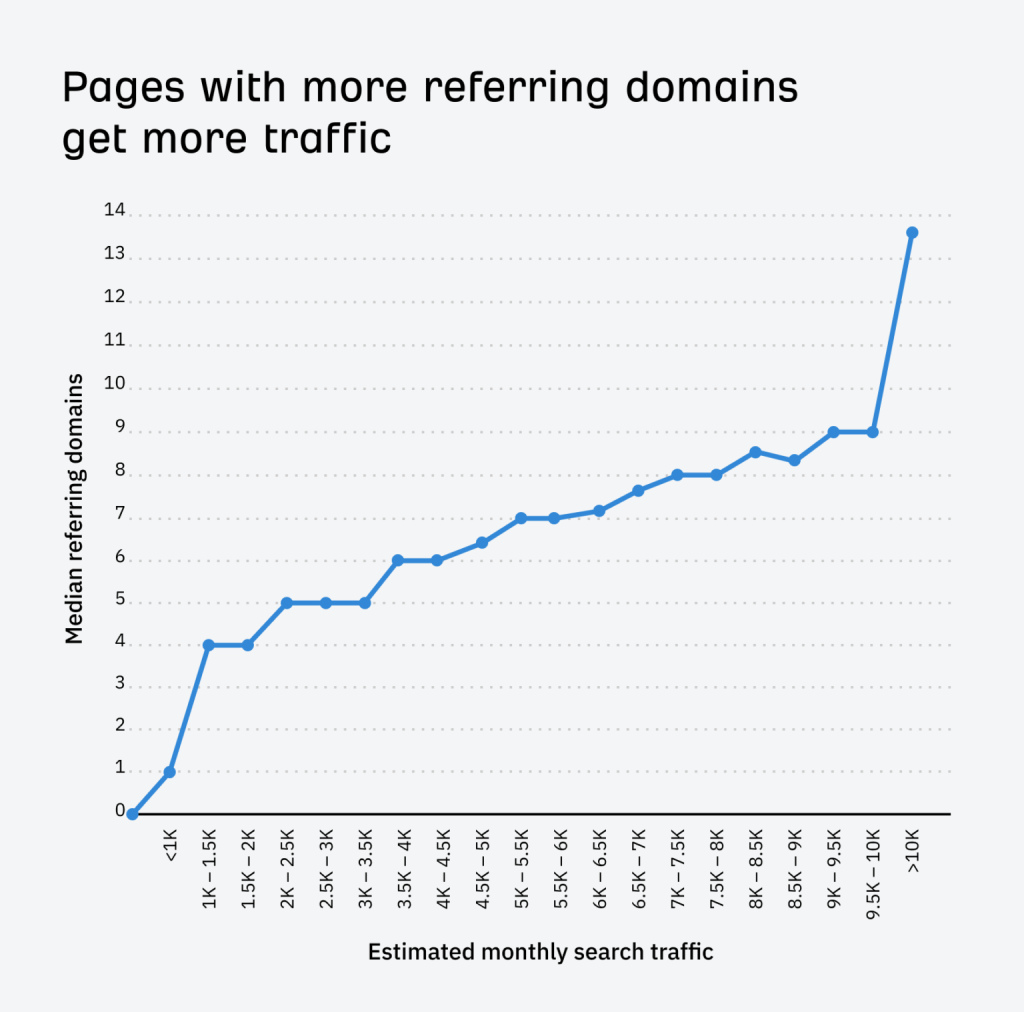
Compared to link quality, link quantity cannot deliver the same benefits. However, more links can lead to increased visibility across online platforms. Having a more significant number of backlinks improves your chances of ranking on top, but only for a shorter period. Similarly, it enhances the referral traffic, as mentioned on Ahrefs, that more referring domains to a page helps drive more traffic.
Source
2 – Wider Reach
A large number of backlinks means that more and more people will see your domain name. Hence, this improved visibility will become your advocate to help more people learn about your site. This broad audience reach directs you to pocket significant perks in terms of reduced SEO efforts.
3 – Short-Term Gains
Link quantity is unsuitable for long-term advantages as Google will capture the non-relevant backlinks and penalize the sites. However, if you already have planned to get short-term gains from your site, you should look forward to creating more and more links to every site you come across.
Link Quality vs. Quantity – Which is More Important?
Based on the benefits provided by both strategies, a large number of backlinks can be helpful f
or small-term benefits. For example, you can leverage the potential of this approach for your APK mods website or films and TV shows platforms. The main reason is that these sites don’t persist longer in this competitive landscape. Thus, a larger quantity will boost it for ranking at the top, and you can pocket the desired advantages.
On the other hand, building quality backlinks is essential if you have planned to get long-term advantages. As per the new Google updates, it does not penalize the site with higher authority links. Thus, you need not worry about the position or ranking of your site in the search engine. In this way, link quality matters more than link quantity. One good backlink can deliver more significant advantages than 100 low-quality links.
Proper Link Building Strategy
Although the quality of the links is more important than quantity, you should generate a strategy to accommodate both in a well-organized way to get the advantages. We have mentioned the proper link-building process in the following section.
1 – Prioritize Relevancy
While creating backlinks, you must prioritize the relevancy of backlinks. Identify the niche of your blog or site and find the relevant keywords to write articles on. Then, you must research well to find the relevant websites. After performing this task, you must reach the owners to let them learn about your site and ask for the backlink. As a result, you can start building your authority.
2 – Seek Quality Score
Getting links from niche-relevant sites only is not functional anymore. You must go one step ahead to ensure the quality score of the backlinks. When researching the sites, you must add one more factor to find the websites with higher domain authority alongside relevancy. By seeking a quality score, you can improve your chances of ranking at the top of the search engine.
3 – Diversify Quality Link Profile
Besides link quality, quantity is also essential if received in a proper manner. You must work strategically to expand your backlink profile. However, it is a must requirement to ensure the relevancy and authority of the linking websites., Otherwise, you have to face negative consequences instead of benefits.
4 – Monitor and Adjust
Lastly, you must monitor the quality and quantity of your backlinks and adjust them according to the current standards. By analyzing the potential anomalies in your strategy and then tackling them with effective tactics, you can direct your website to reach the top of the ranking and receive organic traffic.
There is no clear answer about the winner between link quality and quantity. Both aspects play crucial roles in an effective SEO strategy, and their relative importance can vary depending on your goals and niche. Prioritize relevance, authority, and trustworthiness when seeking high-quality links while also considering the potential benefits of a diverse link profile that includes a moderate quantity of links.
Remember that SEO is an ongoing process. Therefore, regularly monitoring and adjusting your link-building strategy is critical to long-term success. Further, a holistic approach that combines both will yield the most sustainable and fruitful results for your website’s SEO efforts.
Jamaica’s Director Of Tourism Addresses A.I. At Global Tourism Resilience Conference
HANOVER, Jamaica – Director of Tourism for Jamaica, Donovan White, has emphasized the importance of the human touch in travel and tourism despite the rise in artificial intelligence. Over the last decade, there has been a rapid advancement and increasing integration of Artificial Intelligence (AI) technology across various sectors including tourism.
Speaking at the Global Tourism Resilience Conference (Feb. 24th) during a panel on “Harnessing, Generative Artificial Intelligence for Tourism Resilience,” the Director of Tourism highlighted, “Since its emergence, the tourism industry has utilized AI to improve features like customer experience, reduce costs, and streamline operations – and it has been transforming the industry.
However, the human element of travel is irreplaceable. Only humans can provide insights into particularities like the best time to visit a location for an excursion, who at the hotel mixes the best drinks or offer the best rates through personal contacts. AI cannot pick up on these complexities.”
The panel featured several industry experts in AI and focused on the transformative impact of AI in fortifying the tourism sector against various challenges. It also looked at how AI technologies can be leveraged to enhance predictive analytics and automate customer service.
The 3rd Global Tourism Resilience, taking place from February 17-19 at Princess Grand in Negril, features keynote speeches, panel discussions, and workshops centered around navigating challenges and leveraging opportunities in the tourism sector.
Jamaica’s tourism is embracing these new AI technologies to make it easier to book and enjoy our destination. A recent development is that our AI-powered chatbot (Virtual Jamaica Travel Specialist) delivers 24hr customer assistance on Visit Jamaica.com and now converses in up to 10 languages. Jamaica’s enviable 42% visitor repeat rate is however because of our warm and authentic hospitality by our people,” said Director of Tourism for Jamaica, Donovan White.
The Jamaica Tourist Board is utilizing these AI trends to help forecast future trends, demand, and customer preferences, enabling proactive decision-making and resource optimization. This enhances the Board’s ability to cater to evolving traveler needs and stay competitive.
The 3rd Global Tourism Resilience, taking place from February 17-19 at Princess Grand in Negril, features keynote speeches, panel discussions, and workshops centered around navigating challenges and leveraging opportunities in the tourism sector.
Roberta Flack and Maxi Priest in Set The Night to Music
SOUTH FLORIDA – Maxi Priest was on top of his game in 1991 when he got a call at his London home from R&B legend Roberta Flack. Within weeks, they were recording Set The Night to Music, which became a massive seller that year.
One year earlier, Maxi Priest had hit number one on the Billboard Album chart with Bonafide, which yielded the hit single, Close to You. A hit with Flack — who died on February 24 in New York City — was the icing on the cake.
“As for whose idea the collaboration was, I truly don’t know. Maybe someone told me at some point, but honestly, what stays with me is that moment — the fact that Roberta Flack called my home phone. That is the clearest memory of how it all started, and it will forever live with me, especially between me, my sister Rose, and Roberta,” the British singer told South Florida Caribbean News.
Written by Dianne Warren, Set The Night to Music was originally recorded by American rock band Starship. Like that cut, the Roberta Flack/Maxi Priest version went into the Billboard Hot 100 chart, peaking at number six.
Flack, who was 88, had been ailing for some time. In 2022, she was diagnosed with ALS which forced her to retire from performing.
A graduate of Howard University, Flack was a formally-trained vocalist. She had a number of hit songs. Including Killing Me Softly With His Song, and The First Time Ever I Saw Your Face. Plus, Feel Like Making Love, and The Closer I Get to You (with Donny Hathaway).
The North Carolina-born artist had close ties to Jamaica, visiting the country frequently during the 1970s. She was close friends with Bob Marley and Kapo, a spiritual leader.
“Roberta always spoke about her love for Jamaica, the music, the culture, the food, and the fact that she knew a lot of people from there. Of course, I loved the fact that she had such strong connections to Jamaica. Maybe that’s one of the reasons why I got to do the collaboration with her—in which case, I’m so thankful for it,” said Maxi Priest, who was born in the United Kingdom to Jamaican parents.
The Software as a Service (SaaS) business model has become an integral, key aspect of today’s rapidly evolving technology industry. At the same time, with increasing competition, many SaaS companies are faced with the challenge of differentiating their offerings in a crowded market.
The result is that having your business online is no longer an option, it’s a necessity. This is where search engine optimization (SEO) can play a key role. By using effective SEO strategies, SaaS companies can significantly improve their business visibility, comprehensively ensuring the possibility of achieving long-term success in a competitive market.
In this blog post, I will explain how SaaS companies can leverage SEO to reach a wider audience and convert effectively.
Let’s start!
What is the Role of SEO in SaaS?
What is SEO? First of all, SEO is an effective digital marketing strategy that is designed to comprehensively increase the visibility of a website in search engines such as Google, Bing, and Yahoo.
For SaaS businesses, SEO is a critical tool that allows you to actively attract organic traffic, increase the current level of trust of website visitors, and turn visitors into loyal customers who will eventually become regular buyers of your products or services that you sell on your website.
Most potential users turn to search engines in search of solutions to their problems, SaaS companies must position themselves as an authoritative source in their industry, this is where SaaS SEO services come to the rescue, as they can quickly increase the visibility of your website in the vastness of numerous search engines.
At a time when everyone has constant access to the Internet, consumers have access to huge amounts of useful and necessary information that they can find in just a few clicks. To attract their attention, SaaS companies must ensure that their websites rank high for relevant search terms. A well-implemented, well-thought-out search engine optimization strategy can create a solid foundation for continued growth, enabling companies to attract high-quality leads and build a sustainable user acquisition process.
Why is SEO Critical for SaaS Companies?
SaaS companies often operate in highly competitive markets where customers are becoming increasingly savvy and discerning. As a result, traditional forms of advertising and marketing efforts may not be as effective at building long-term, trusting relationships. SEO offers several key benefits that can directly impact a SaaS company’s bottom line:
Cost-effective lead generation
Paid advertising can produce quick results, but it requires ongoing investment to maintain visibility. On the other hand, SEO provides a long-term strategy for driving organic traffic. By properly optimizing your website for relevant keywords and creating valuable content, SaaS companies can attract visitors without the ongoing costs of pay-per-click (PPC) campaigns;
Increased visibility
Visibility is crucial for SaaS companies. The higher a website ranks on search engine results pages (SERPs), the more likely it is to attract the clicks it needs. A solid SEO strategy ensures that your SaaS product appears in front of potential customers exactly when they are searching for the solutions they need. Effective SEO tactics can place your company at the top of search results, offering a significant advantage over competitors who may rely on paid channels;
Improved user experience
A key component of SEO is comprehensive user experience (UX) optimization on your website. Search engines always reward websites that provide intuitive navigation, fast loading, and mobile responsiveness. By focusing on improving the user experience, SaaS companies significantly improve their SEO rankings, and increase customer satisfaction.
A long-term strategy that works reliably
Unlike paid advertising, which can stop generating traffic at any time as soon as a marketing campaign ends, SEO is a long-term, reliable strategy that builds over time. As you consistently publish high-quality, unique, and informative content, build backlinks, and properly optimize your website, the key benefits continue to grow. Over time, the authority and relevance of your website increase, helping to ensure consistent traffic and high-quality leads.
What are the Key SEO Strategies for SaaS Companies?
To effectively leverage all the available SEO opportunities, SaaS companies must implement a comprehensive strategy that includes several important components.
Keyword Research
Thorough keyword research and proper keyword optimization are some of the first steps in an effective SEO strategy. SaaS companies need to have a good understanding of the search terms that potential customers use to find their products. By targeting long-tail keywords and phrases related to your SaaS solution, you can attract users who are looking for your type of services. Keyword optimization should be incorporated into on-page elements such as titles, meta descriptions, headings, and body content.
Quality Content
Content marketing and blogging, with regular publication of interesting, informative, and unique content, is crucial for both SEO and customer engagement. SaaS companies can benefit greatly from a content marketing strategy that addresses common customer problems, explains in detail various key product features, and answers any questions that potential customers may have. Blogging is a great way to build trust with your target audience, answer common questions, and generate organic traffic.
On-page SEO
On-page SE
O refers to the elements on your website that can be effectively optimized to significantly improve your search engine rankings. On-page SEO includes title tags, meta descriptions, image alt text, and internal links. Make sure these elements are optimized for your target keywords, as this helps search engines understand the context of your pages and improves their chances of ranking higher in search results.
Backlinks
Building backlinks provides an opportunity to signal to multiple search engines that your website is trustworthy and authoritative in its industry. SaaS companies should focus as much as possible on gaining backlinks from authoritative industry websites, blogs, and publications.
Technical SEO
Technical SEO ensures that your website is technically easy for search engines to crawl thoroughly. Technical optimization includes optimizing for page speed, ensuring it is mobile-friendly, implementing an XML sitemap, and fixing any broken links or errors that are affecting the website’s functionality.
Conversion Rate Optimization
Conversion Rate Optimization (CRO) is important for SaaS companies, as it is the process of converting traffic that has been attracted to your website into paying customers. CRO focuses on optimizing the elements of your website that influence current conversions. Conversion Rate Optimization includes optimizing call-to-action buttons, simplifying forms, and using compelling copy. By increasing your current conversion rate, you ensure that the traffic generated through your SEO efforts will lead to real growth for your business.
Summary
SEO is an essential part of any SaaS company’s long-term growth strategy. By improving visibility, driving organic traffic, and providing a better user experience, companies can build a sustainable online presence that attracts high-quality leads. Implementing a comprehensive SEO strategy gives SaaS companies a competitive advantage and new opportunities to grow their business.
For SaaS companies, who may not have the in-house resources or expertise to fully implement all of the above effective strategies, professional support is paramount. By partnering with experienced experts at SEO Agency Panem, companies can optimize their online presence while focusing on their core business. Productive collaboration with qualified professionals will help optimize your current marketing strategy, provide the opportunity to improve search rankings, and ultimately attract more quality potential customers.
PORT OF SPAIN, Trinidad – Soca icon Machel Montano releases his new album One Degree Hotter (Monk Music/Symphonic) today. With its infectious beats and high-energy rhythms, the 16-track LP ignites pure joy, freedom, and unapologetic celebration during the peak of Trinidad’s Carnival season — when parades of costumed revelry and Soca music dominate the streets.
The album kicks off with a brand new remix featuring R&B pop legend Ne-Yo on “Truth & Balance”, Machel’s Caribbean musical fusion with Jamaican dancehall artist Ayetian and producer DJ MAC. Then, Machel turns up the dial with another international superstar, Nigerian hitmaker Davido, on “Fling It Up”.
The song already landed at #48 on Billboard’s Afrobeats Songs chart. Additionally, Machel and Davido will shoot the music video for this banger in Trinidad during Carnival.
Road March Title
As Machel Montano’s Carnival tour is in full swing (check the dates below), the album’s lead single “PARDY” (produced by XplicitMevon & BadjohnRepublic) is the #1 song in his native country of Trinidad and the top contender for the coveted Road March title at Carnival this year. If he wins, Montano will tie the legendary Lord Kitchener with 11 titles, the most of all time.
The album also delivers a special “PARDY (Road Mix)”, produced by MadnessMUV x D Ninja x DJ Marcus Williams, ready to debut and pump through the Carnival truck speakers. Whether you’re on the road, in the club, or just need a soundtrack to your celebration, One Degree Hotter will be a scorcher for all seasons.
Machel Montano’s upcoming album, One Degree Hotter, cleverly plays on multiple meanings. Not only does it reflect his continued success with a streak of chart-topping hits, but it also nods to his recent academic accomplishment—earning a Master’s degree in Carnival Studies from the University of Trinidad & Tobago.
After spending two years on his Master’s degree, Machel explored his cultural heritage and thought about his roots. He returned to the studio more inspired than ever. He poured the knowledge and insights gained from his studies into this new project.
One Degree Hotter serves as both a tribute to his educational achievement and a symbol of his drive to elevate his music to new global heights. He said tracks like “Fling It Up” featuring Davido, and “Pepper Vine” with Lady Lava and Drupatee, are prime examples of his vision—infusing Soca with vibrant influences from Africa and India, pushing the genre’s boundaries. This album marks a bold new chapter in both his musical evolution and his larger mission to take Soca worldwide.
Following the success of his 2021 album, The Wedding Album, which featured collaborations with the likes of Afro B, Ms. Lauryn Hill, Teddy Riley, and Vybz Kartel, One Degree Hotter continues to show Machel’s innovative approach to music.
MACHEL MONTANO
Machel Montano comes from Port of Spain in Trinidad & Tobago. He has shared his music with the world for 43 years. Since he was a child, Machel has led the Soca music genre. He has won many awards and helped bring Soca music to the international stage.
Machel is the winner of 10 Trinidad & Tobago Road Marches, 7 International Soca Monarch titles and a Soul Train Award for Best International Performance. New York Times raves “his place as soca’s most transformative star is undeniable.”
The artist has collaborated and shared stages with some of the world’s most renowned music icons like Rihanna, Ariana Grande, Pitbull, Drake, Nicki Minaj, Mighty Sparrow, Calypso Rose, Black Stalin, Mighty Shadow, Shaggy, and many more. He has packed out arenas worldwide, including selling out Madison Square Garden multiple times and performing alongside Major Lazer on Coachella’s main stage.
SOUTH FLORIDA – Florida-based Jamaican artiste King Swagah has released an inspirational track titled Ghetto Starsthat he hopes will motivate listeners.
Produced by J Sharp with whom the artiste has been working since 2008, the track was officially released on January 23.
“I wrote this for the poor people worldwide so they can build back their self esteem. So far, the response has been good and my long term goal is to keep doing positive, inspirational and encouraging music for my fans worldwide. I also want to give back and help out many people,” the artiste whose given name is Elvis Paisley said.
The entertainer, who has been a music professional for almost two decades is known for other tracks such as Journey, Not Giving Up, Harder and Prosperity.
King Swagah grew up with a father who had a sound system. He was also close to the famous producer Jack Ruby. These experiences have greatly influenced his music. Jack Ruby is known for his work with Burning Spear in the 1970s.
In the meantime, the St Mary-born Ocho Rios High School graduate is urging new artists to create more positive songs.
“I’m a 1974 baby, meaning, I grew up listening to the 80s and 90s dancehall artistes. From the 2000s, it has changed to a more negative message for the people. Still, I’m going to remain positive with this new generation of dancehall artistes. In my own opinion, they just need to start writing some positive music and secure what Bob Marley and others started us out with some good music,” King Swagah said.
Piarco, Trinidad & Tobago – On Saturday, February 22, Caribbean Airlines hosted its annual Carnival event “Culture in D’ Park” at Nelson Mandela Park, Port-of-Spain, Trinidad.
This is the 3rd year the company has held Culture in D’ Park, which was conceptualized in 2023. This year’s event has grown significantly, with the largest public turn out thus far.
The park was transformed into a Cultural Village where patrons were treated to a parade of traditional Carnival characters including, Midnight Robbers, Moko Jumbies, Dame Lorraine and Kings & Queens of carnival, under the umbrella of the airline’s 2025 theme “Home is where the heart is…”
Trinidad & Tobago Carnival
Children making Pierrot Grenade outfits at a workshop at the Caribbean Airlines “Culture in D’ Park” at Nelson Mandela Park on Saturday 22 February 2025.
There were many carnival-themed activities for children and the entire family, including traditional mas painting, Pierrot Grenade outfit construction and other workshops. As part of its community sustainability pillar, Caribbean Airlines specially hosted 250 children from various children’s homes across the country, giving them the opportunity to experience first-hand, the artistic traditions of Trinidad & Tobago Carnival.
Caribbean Airlines CEO, Garvin Medera with some of the day’s winners. Patrons had the opportunity to win tickets to several of the airline’s destinations and packages for Caribbean Iere Mas J’ouvert.
Caribbean Airlines CEO Garvin Medera in commenting said: “Our ‘Welcome Home’ theme continues to resonate with our people; and this year’s ‘home is where the heart is…’ is an extension of this concept. We recognize the key role Caribbean Airlines plays in promoting Carnival and providing opportunities for future generations to have an appreciation for the artform and the detail that goes into the planning of the festival. I am really pleased to see Culture in D’ Park taking its place as a staple event on the Trinidad Carnival calendar. We thank the public for coming out in their large numbers to support this cultural event”.
Caribbean Airlines Theme Song
The day’s activities culminated with performances by soca icons, Machel Montano, Bunji Garlin and Mical Teja who delivered an energetic rendition of the Caribbean Airlines theme song for 2025 “Home Is Where The Heart Is”. Entertainment was also provided by the Malick Folk Performing Company, pannist Joshua Regrello and many others.
Welcome Home Airport Activation
This event kick-started Caribbean Airlines’ culture programme for 2025, which continues with a Welcome Home Airport Activation at the Piarco International Airport on February 24, Caribbean Iere Mas J’ouvert on March 3 and will include other events in the coming months, like Caribbean Airlines Village Cricket T10 tournament, which is expanding this year, to include Antigua and Barbados.
Caribbean Airlines expresses its gratitude to the following companies for their contribution: Angostura, Bermudez, Blue waters, KC Candy, Shine Distributors, Sunshine Snacks, Toppers, Vemco.
A cross section of the audience at the finals of the Ultimate Soca Champion competition at the Queen’s Park Savannah on Thursday February 20th, 2025.
PORT OF SPAIN, Trinidad – The greens of the Queen’s Park Savannah came alive last evening, as the inaugural Ultimate Soca Champion competition finals were held with electrifying performances and accompanying theatrics. This historic event was a beat-to-beat battle for the ages which crowned its first Youth Soca Champion, and will subsequently crown the first Ultimate Soca Champion on Friday February 28th, 2025 – “Fantastic Friday”. As such, it marked a significant milestone in Trinidad and Tobago’s Carnival, reigniting the competition element for interested artists, both established and emerging.
The Ministry of Tourism, Culture and the Arts is proud to support this initiative which promotes both the local and regional music industry but moreover, the Soca genre. Beyond the high-energy performances and grand prizes, this competition represents a steadfast commitment to the sustainable growth of Soca, its artistes, and the production value of the sector.
Senator the Honourable Randall Mitchell, Minister of Tourism, Culture and the Arts who attended the finals proudly remarked, “The success of the Ultimate Soca Champion competition has exceeded all expectations: showcasing the incredible talent of our artistes and the vibrancy of Soca music. Plans are already underway for the 2026 and 2027 editions, and we look forward to many more years of celebration, enjoyment, growth, and global recognition of our national heritage.”
In collaboration with Jerome ‘Rome’ Precilla, and the Star Global Productions team and partners, Minister Mitchell notes that this event marks a new chapter in Trinidad and Tobago’s cultural landscape.
The Journey: From Vision to Reality
Since 2020, the absence of the ‘Soca Monarch’ experience in Trinidad’s Carnival has been felt by artistes and citizens alike. Soca has always been more than just music – it is a movement powered by community. The overwhelming support of fans and families throughout the competition is a testament to the unbreakable bond between artistes and their community of supporters.
The unmatched energy in the Savannah reaffirmed the power of Soca, and supported this reintroduction of a competition element – for the benefit of the art form. The added value of a dynamic, thoughtfully-produced media experience has also brought the Ultimate Soca Champion competition to households across Trinidad and Tobago, the Caribbean region, and around the world over the past weeks. This, via local television station – CNC3 with new episodes aired weekly until the grand finale on “Fantastic Friday”.
The Ultimate Soca Champion competition has also marked a significant step towards the regionalisation of Trinidad and Tobago’s approach to the music industry. By welcoming artistes from across the Caribbean, this competition has set a precedent for greater collaboration and inclusivity in Soca’s continued evolution. This debut edition featured an impressive mix of local and regional talent, reinforcing the importance of a unified Soca industry.
Looking Ahead: 2026 & Beyond
As the Soca industry progresses, so must its artistes. The Ministry of Tourism, Culture and the Arts supports all performers as they continue to perfect their craft both on and off-stage.
This sentiment is also shared by the competition’s Showrunner, Jerome ‘Rome’ Precilla who stated “Competition encourages excellence. Some of the best performances you see are on a competition stage.”
Precilla is confident in the future of the Ultimate Soca Champion competition with the goal of encouraging more local and international artistes to showcase their talents, enhancing production quality, and incorporating cutting-edge technology and staging to elevate the audience experience.
With this landmark event, the Ultimate Soca Champion has redefined what is possible for the genre, proving that Soca is not only here to stay—it is poised to reach even greater heights.
Minister of Tourism, Culture and the Arts, Senator the Honourable Randall Mitchell and Ms. Keiba Jacob Mottley, Chief Executive Officer of the National Carnival Commission of Trinidad and Tobago presents the winning prize to Nkosi Sucre.‘Sucre’ the winner of the Youth Soca Champion category at the finals of the Ultimate Soca Champion competition at the Queen’s Park Savannah on Thursday February 20th, 2025.
Last evening, Nkosi Sucre – ‘Sucre’ was crowned the winner of the Youth Soca Champion category performing his hit “The Greatest” and taking the grand prize of TTD$200,000.00. Tobago’s Jaheim Thomas – ‘Verse’ placed second with “Pump It Up” and Jahmike Bonas – ‘Christo’ came in third with his song “Unity”.
The Ultimate Soca Champion winner, as previously mentioned, will be announced in the Grand Finale of the television production, to be aired on CNC3 next Friday, and will take home the grand prize of TTD$1,000,000.00. Winners of the competition will receive over TTD$2,000,000.00 in cash and prize winnings, in total.